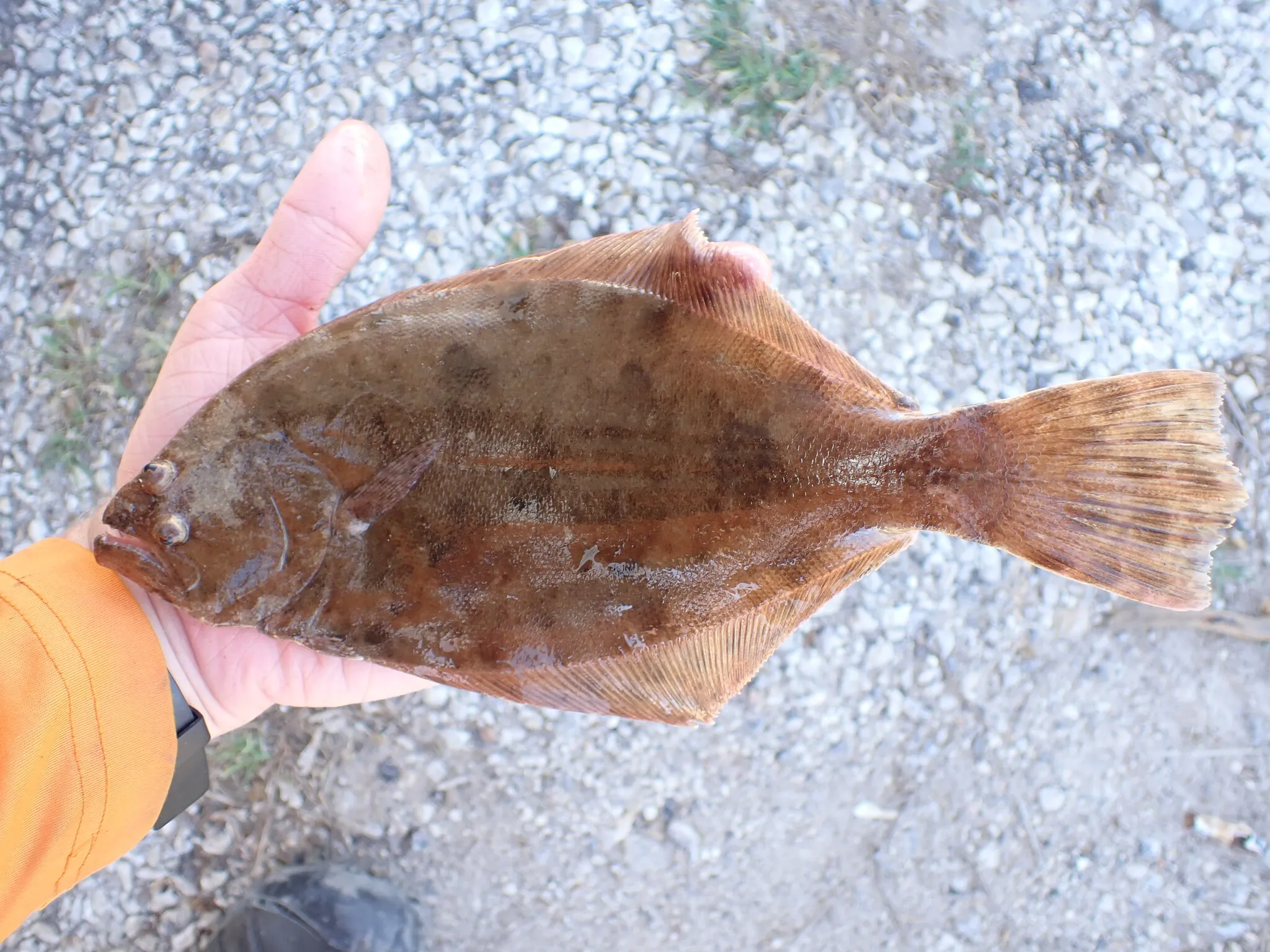
Photo: Fishes of Texas team / CC BY-SA via iNaturalist
Texas Flounder Season 2026-27: Limits, Size & Closure
Texas flounder limits for 2026-27, checked against the new TPWD Outdoor Annual: the Nov 1 to Dec 14 closure, measuring a keeper, and where to gig near Freeport.
The Texas flounder season closes every year from November 1 through December 14; the minimum size limit is 15 inches total length and the daily bag limit is 5 fish. Those three numbers cover almost every question anglers ask before a trip. Gigging is legal during the open season and is a genuine local tradition in the Brazosport area, with dedicated charter operations running night flounder trips through the Christmas Bay complex each fall, and most first-timers book a Freeport flounder gigging trip with someone who already owns the rig.
The fish behind those numbers is southern flounder (Paralichthys lethostigma), an ambush predator that lies flat on the bottom, often partially buried, and strikes upward at passing baitfish.
Here is everything you need before you go: the current size and bag limits, how to measure a fish so you stay legal, what happens if you keep a short one, where to gig near Freeport, what the latest science says about flounder numbers, and how to target them on rod and reel. Seasonal patterns and tackle are covered further down this page.
What is the legal size limit for flounder in Texas?
The legal size limit for flounder in Texas is a 15-inch minimum total length, with no maximum. Any flounder shorter than 15 inches must be released. The following limits are valid September 1, 2026 through August 31, 2027, per TPWD’s flounder bag and length limits page, and they apply to southern flounder, gulf flounder, and all other flounder species and their hybrids.
| Rule | 2026-27 Limit |
|---|---|
| Minimum length | 15 inches (total length) |
| Maximum length | No limit |
| Daily bag limit | 5 fish |
| Possession limit | 5 fish (equals daily bag) |
| Annual closure | November 1 through December 14 (bag limit = 0) |
| Season reopens | December 15 |
The same limits apply whether you catch the fish on rod and reel or by gigging, and whether you are fishing the bays, the jetties, or the surf. A Texas fishing license with a saltwater endorsement is required to keep flounder in both state and federal water.
What is the Texas flounder bag limit?
The Texas flounder daily bag limit is 5 fish per angler, and the possession limit equals the daily bag, so you may have 5 flounder in hand at any time. Per TPWD’s flounder bag and length limits, every fish must also meet the 15-inch minimum total length, and the limit applies to southern flounder, gulf flounder, and their hybrids combined. The 5-fish bag is in effect statewide whenever the season is open.
During the November 1 through December 14 closure the bag limit drops to zero by every method, so no flounder may be kept during that window. The bag and possession limits reset daily: a multi-day trip does not let you stockpile more than 5 fish per person per calendar day.
How do you measure a flounder for the size limit?
Flounder are measured by total length, so you measure the whole fish, not the body alone. Lay the flounder flat with its mouth closed and measure in a straight line from the tip of the snout to the tip of the tail. Per TPWD’s general fishing regulations, total length is measured with the tail fin squeezed or pinched together to give the maximum overall length, so a fish gets the benefit of its longest possible measurement.
That pinched-tail detail matters on a flounder, because the broad tail can add close to an inch when it is fanned out versus pinched. Carry a rigid measuring board or a tape stuck to the gunwale, lay the fish flat, and close the tail. If a fish is borderline at 15 inches, the safe and legal call is to release it. A game warden measures the same way, and “it looked close” is not a defense.
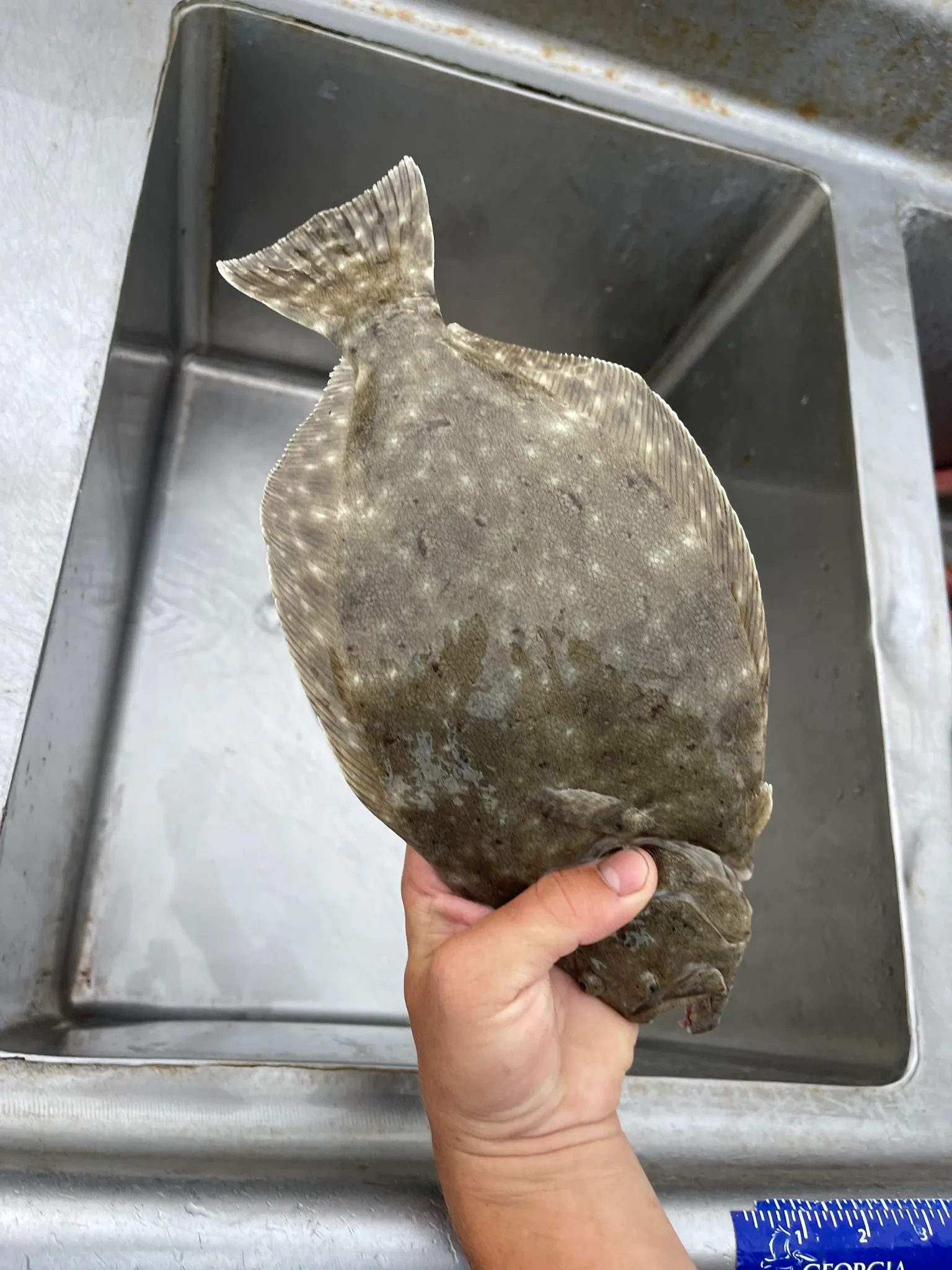
Southern flounder lie flat on sand and mud. Measure total length with the tail pinched together, to 15 inches, before keeping one.
What is the penalty for keeping an undersized or over-limit flounder?
Keeping a flounder under 15 inches, or more than 5 in a day, is a Class C Parks and Wildlife Code misdemeanor. Per TPWD’s laws, penalties, and restitution rules, a Class C violation carries a fine of $25 to $500, and each illegal fish can be charged as a separate violation, so a cooler of short flounder adds up fast.
The fine is not the end of it. TPWD also pursues civil restitution for the replacement value of the wildlife taken, on top of any criminal fine. Refusing to pay restitution blocks you from buying new licenses or tags, and serious or repeat offenses can escalate to license suspension for up to five years and forfeiture of the gear used. The economics strongly favor releasing anything short.
Did the flounder limits change for 2026?
No. The size limit, bag limit, and closure dates are unchanged for the 2026-27 license year: a 15-inch minimum, a 5-fish daily bag, and the November 1 through December 14 closure. The TPWD flounder limits page lists these as valid September 1, 2026 through August 31, 2027.
Flounder rules have changed meaningfully in recent years, so it is worth checking each license year rather than assuming. After the 2020 emergency action, TPWD raised the minimum size and reworked the fall closure into the current November 1 through December 14 window. For the 2026-27 year, the framework is the 5-fish, 15-inch, mid-fall-closure structure described above.
Why is flounder season closed in November?
Texas closes flounder season from November 1 through December 14 to protect the fish during their fall spawning migration, when they concentrate in Gulf passes and become extremely vulnerable to harvest. Flounder are fall spawners: as water temperatures cool in October and November, southern flounder migrate from the bays toward Gulf passes to spawn offshore. During this migration they concentrate in the passes and nearshore waters in predictably high numbers, which historically made them extremely easy to harvest, particularly by gigging.
That vulnerability is exactly why TPWD protects the window. Flounder killed during the spawn run never reproduce, and the concentrated nature of the migration means pressure during this period is disproportionately damaging to the population. The closure is a state rule because flounder are an inshore, state-water species, set by Texas Parks and Wildlife rather than federal managers, the distinction we cover in our guide to Texas state waters versus federal waters.
The closure originally came out of a 2020 emergency action when TPWD halted the fall gigging season entirely due to declining stock assessments. The November 1 through December 14 window became a permanent fixture in the regulations the following year.
What makes this closure especially important: a 2024 study by Texas Sea Grant and the Harte Research Institute found that traditional creel surveys had been massively undercounting flounder harvest. By analyzing over two and a half years of guided gigging trip photos posted to Facebook, researchers found that when nighttime gigging was factored in, total annual flounder harvest was nearly double previous estimates. The real harvest pressure on the population had been invisible to managers for years.
That finding reframes the conservation story. It is not just that flounder numbers declined; the full scale of the pressure causing the decline was not understood until recently. The closure is a direct response to that data.
When are flounder in the Brazosport bays?
Flounder are in the bays all year, but the fishing is only good for part of it. The open season runs year-round except November 1 through December 14, and the rod-and-line peak is September and October, when fish feed hard before the spawning migration. Here is how a Brazosport year reads, month by month.
| Period | Status | Notes |
|---|---|---|
| January to February | Open | Slow; fish offshore or near the passes |
| March to April | Open | Improving as the bays warm |
| May to June | Open | Active; grass-bed edges |
| July to August | Open | Early and late hours |
| September to October | Open | Peak; fall feed before the migration |
| November 1 to December 14 | Closed | No flounder by any method |
| December 15 onward | Open | Slow for weeks as spawned fish return |
Freeport mornings during the fall flounder run (October and November) were fishable about 46% of mornings (good outright 18% of the time, across 305 graded mornings), per our 2021–2025 conditions archive.
When Flounder Are Seen Near Freeport
Research-grade iNaturalist observations by month within 75 km of Freeport — a proxy for when the species is active and around, not a catch count.
Loading the seasonal pattern…
Flounder Gigging in the Brazosport Area
Gigging is an established part of the Freeport fishing calendar, not a niche activity. Multiple guide operations run dedicated flounder gigging charters out of the area, working the West Galveston Bay and Christmas Bay complex in particular. The local season, when conditions are best, runs late August through October before the November closure.
The activity also shows up in tournament fishing. Fishin’ Fiesta, Brazosport’s major annual fishing event held each July since 1947, includes a largest flounder category in its inshore division. The River’s End Fishing Tournament also carries a flounder category.
Gigging is not technical fishing. You are moving slowly through shallow water, by wading or by boat, with a bright underwater light aimed at the bottom, looking for the distinctive outline of a flounder lying flat in the sand. A gig pole with a pronged tip is thrust straight down when a fish is spotted. The light, not the gig technique, does most of the work.
Where is the best flounder gigging near Freeport?
The Christmas Bay complex is the best flounder gigging area near Freeport, the most consistently cited productive spot in the region: hard sand bottoms with good water clarity and manageable depths for wading and poling a shallow boat. It sits in the same lightly pressured Brazosport bay system that makes Freeport a quieter inshore alternative to Galveston.
Named locations with the most forum and charter mentions:
| Location | Notes |
|---|---|
| Christmas Bay complex | Top local area; sand bottom, clear water, accessible by shallow-draft boat |
| Churchill Bayou | South end near Amigo Lane put-in; productive but muddy near the marsh shorelines |
| Drum Bay / Rattlesnake Point | South shoreline; firm sand bottom near marsh drain outflows |
| West Galveston Bay south shore | Hard sand bottom outside marsh drains; the bay system north of the Freeport complex |
| ICW edges (Bastrop Bayou, Chocolate Bayou, Oyster Creek drains) | Flounder hold near current and structure along the intracoastal |
| Brazos River mouth flats | Active bait movement concentrates flounder near the river outflow |
Best conditions for gigging: calm water with no chop (wind under 10 mph), clear visibility to the bottom, incoming or early outgoing tide, water temperatures in the 65 to 75°F range. September and October are peak months. Nights around the new moon give the darkest conditions and make your light more effective. Check current Freeport fishing spots and conditions before you launch.
Is flounder season different around Galveston Bay?
No. Flounder season, the 15-inch minimum, and the 5-fish bag are the same statewide, so the rules around Galveston Bay are identical to the Brazosport bays an hour south. Texas sets one flounder rule set for the entire coast: the same September-through-October peak, the same November 1 through December 14 closure, and the same limits whether you fish Galveston, West Bay, or Christmas Bay. There is no Galveston-specific flounder regulation.
What differs is the water, not the law. Galveston Bay is the larger, better-known, and more heavily fished system, while the Brazosport bays south of Freeport see a fraction of that pressure on the same inshore species. The Christmas Bay complex and the West Galveston Bay south shore both sit at the quieter end of that gradient, which is why local flounder giggers favor them. For how the two systems compare on crowds, access, and the overall inshore fishery, see our guide to Freeport versus Galveston for inshore fishing.
What does a guided gigging trip provide?
A guided night gigging trip supplies the whole rig: a shallow-draft boat that can work water too thin to float most hulls, the submersible lights and the power source that run them for hours, and the local read on which flats hold fish on a given tide and wind. That equipment is the barrier, not the skill.
Assembling all of it for a couple of nights a year is why most first-timers here book a trip instead. Gigging is legal in Texas during the open season with the standard 15-inch minimum and 5-fish bag applying, and it is prohibited outright from November 1 through December 14.
Rod and Reel Flounder Fishing Near Freeport
You do not need to gig to catch flounder. Charter trips from Freeport regularly produce flounder on conventional tackle, and September through October is the peak season on rod and reel as well. The same 15-inch, 5-fish limits apply.
Tactics that work:
Flounder lie on the bottom and grab a bait before they move, so the bite is a hold, not a strike. Work a slow drag along channel edges, spoil banks, and structure, and give the fish a few seconds before setting the hook.
Productive lures and rigs near Freeport:
- Gulp! Swimming Mullet or Shrimp on a 1/4 to 3/8 oz jig head, the single most consistent producer for inshore flounder statewide
- Live mud minnows or finger mullet on a Carolina rig (egg sinker, 12 to 18 inch leader, #2 hook)
Best spots on rod and reel:
- ICW channel edges and spoil bank drop-offs
- Mitchell’s Cut and the Quintana Island passes, best on a moving tide, fishing the drop-off on the down-current side
- Brazos River mouth, where flounder stack near the outflow in the fall
- The south jetty base, where the riprap holds fish feeding on bait moving through the channel
- Grass-bed edges: the sand-to-grass transition around Chocolate Bay and Christmas Bay
- Bay shoreline structure: dock pilings, oyster reefs, any hard bottom transition
The most reliable pattern of all is a marsh drain on a falling tide. As water pulls off the flats through a cut, flounder lie on the down-current edge and ambush bait washing past, so bounce a soft plastic slowly along the bottom and set the hook on the first thump. On a small bait, a flounder left to reposition will swallow the hook.
What’s Happened to Flounder Numbers Since 2020?
Honestly: recovery has been slow and the picture is still mixed.
TPWD’s coastal fisheries stock data shows flounder populations have not rebounded as quickly as managers hoped following the emergency closure. The Stunz 2024 study helped explain why: for years, the real harvest pressure from gigging was not captured in survey data, so managers were working with an incomplete picture of what the population was actually absorbing.
TPWD has responded with a hatchery stocking program that has released hundreds of thousands of juvenile flounder into coastal waters, much of it produced at Sea Center Texas in Lake Jackson. The program is ongoing, though researchers are still working to improve survival rates from the hatchery to the wild environment.
The fishery is being managed more carefully than it ever has been. Whether that translates to meaningfully higher catch rates in the Brazosport bays over the next few seasons is something local captains will report before any published stock assessment does. Check the TPWD coastal fishing reports for real-time anecdotal catch data from Brazoria County.
The honest answer for an angler planning a fall trip: flounder are catchable, the gigging season in September and October is still productive, and the regulation framework is designed to protect the fishery through the critical November spawn window. Fish the open season, respect the closure, measure to 15 inches, and release anything undersized.
Where can you legally gig flounder near Freeport?
The Brazosport bays, the marsh edges off Bastrop and Christmas Bay, and the shallow flats inside the jetties all hold flounder through the fall run, and all of them are open to gigging outside the closure. What varies is access. Much of the productive shoreline is private or reachable only by boat, and the shallow water that gigging depends on is exactly the water that strands an unfamiliar boat after dark.
Two practical notes before you go. Wading and fishing at San Luis Pass are closed on the Brazoria County side, so plan around it rather than through it. And a gig rig needs a bow light, a generator or battery bank, and a shallow-draft hull, which is why most first-timers here go with someone who already owns the setup.
If you would rather not solve the boat problem yourself, flounder gigging charters run out of Freeport and Surfside Beach through the September and October window. Check what’s biting in Freeport right now before you pick a night, and compare the daytime trip types on the Freeport fishing charters page if gigging is not your thing.
Want to target flounder with a local guide?
Find a Freeport Charter Captain
Freeport Fishing Seasons Calendar
Frequently Asked Questions.
What is the size limit for flounder in Texas?
The minimum size limit for flounder in Texas is 15 inches total length, with no maximum, and a 5-fish daily bag. The possession limit equals the daily bag. These limits are valid September 1, 2026 through August 31, 2027 and apply to all flounder species and their hybrids.
What is the Texas flounder bag limit?
The Texas flounder daily bag limit is 5 fish per angler, with the possession limit equal to the daily bag. Every fish must also meet the 15-inch minimum total length, the limit covers all flounder species and their hybrids combined, and it drops to zero during the November 1 through December 14 closure.
How do you measure a flounder for the size limit?
Measure total length: lay the fish flat, mouth closed, and measure in a straight line to the tip of the tail, pinching the tail fin together for the maximum length. It must reach 15 inches to be legal. When a fish is borderline, measure on a flat board and release it if it does not clearly make 15 inches.
What is the penalty for keeping an undersized flounder in Texas?
Keeping an undersized or over-limit flounder is a Class C Parks and Wildlife Code misdemeanor, fined $25 to $500 per violation. On top of the fine, TPWD pursues civil restitution for the value of the fish, and serious or repeat violations can lead to license suspension and gear forfeiture. Each illegal fish can count as a separate violation.
Did Texas flounder limits change for 2026?
No. TPWD's 2026-27 Outdoor Annual, valid September 1, 2026 through August 31, 2027, keeps the 15-inch minimum, the 5-fish daily bag, and the November 1 through December 14 closure exactly as they were. Confirm on the TPWD flounder page before a trip, since rules can change between license years.
When is flounder season in Texas?
Texas flounder season is open year-round except November 1 through December 14, when all harvest is prohibited. The season reopens December 15. The daily bag limit is 5 fish at 15 inches or longer.
Is flounder season different around Galveston?
No. Flounder season, the 15-inch minimum, and the 5-fish bag are the same statewide, so the rules around Galveston Bay are identical to the Brazosport bays, including the same November 1 through December 14 closure. What differs is the water, not the law: Galveston Bay is larger and more heavily fished, while the Brazosport bays south of Freeport see far less pressure on the same species.
Can you gig flounder in Texas?
Yes. Gigging is legal during the open season with standard bag and size limits applying. During the closure, gigging is prohibited along with all other harvest methods. No permit beyond a Texas saltwater license is required.
What tide and water conditions are best for flounder gigging?
Aim for a calm night on a low or falling tide with clear water. Low water concentrates flounder on the flats and shrinks the area you cover, while wind and runoff that cloud the water make fish almost impossible to spot under the light. A windless night after the water clears is ideal; check the wind and tide forecast before you commit.
Should a first-timer gig or use a rod and reel for flounder?
Rod and reel is the easier entry point. Gigging rewards calm, clear nights and a practiced eye for a half-buried fish, and it ties you to a boat with a light. A slow-dragged Gulp! on a jig head along a channel edge or the Brazos River mouth in September and October produces flounder on conventional tackle in daylight with gear you may already own. Many anglers start on rod and reel, then try gigging once they know what a flounder on the bottom looks like.
How do I stay safe from stingrays while wade gigging?
Stingrays share the same shallow sand flats flounder use, so wear sturdy wading boots and do the stingray shuffle, sliding your feet along the bottom rather than stepping down, which nudges rays out of the way instead of stepping on one. Keep your light moving ahead of your feet, and if you do get hit, soak the wound in hot water and seek medical care.
When is the best time to gig flounder near Freeport?
Late September through October, before the November 1 closure. Flounder stage in the shallow bays and along the marsh edges as they move toward the passes for the fall migration, which concentrates them in the shallow, clear water that gigging needs. Calm nights after a cold front are best because the water clears and the fish hold still on the bottom.
Do you need a guide to gig flounder in Texas?
No, gigging is legal for any angler with a valid Texas saltwater fishing license and a freshwater or saltwater stamp as required. What most people lack is the equipment: a shallow-draft boat, submersible lights, and a power source, plus the local knowledge of which flats hold fish on a given tide. That equipment gap is why guided night gigging trips are common on the Brazosport coast.
Can I keep flounder I catch during the closure if I release them immediately?
No. "Catch and release" does not apply to species under a complete closure. The regulation prohibits taking, not retaining. Flounder must not be intentionally targeted during the November 1 to December 14 closure period.
Can I gig redfish or trout at the same time?
No. Gigging (spear or gig) is legal in Texas only for flounder and certain non-game species. Taking redfish, speckled trout, or other game fish with a gig is illegal.