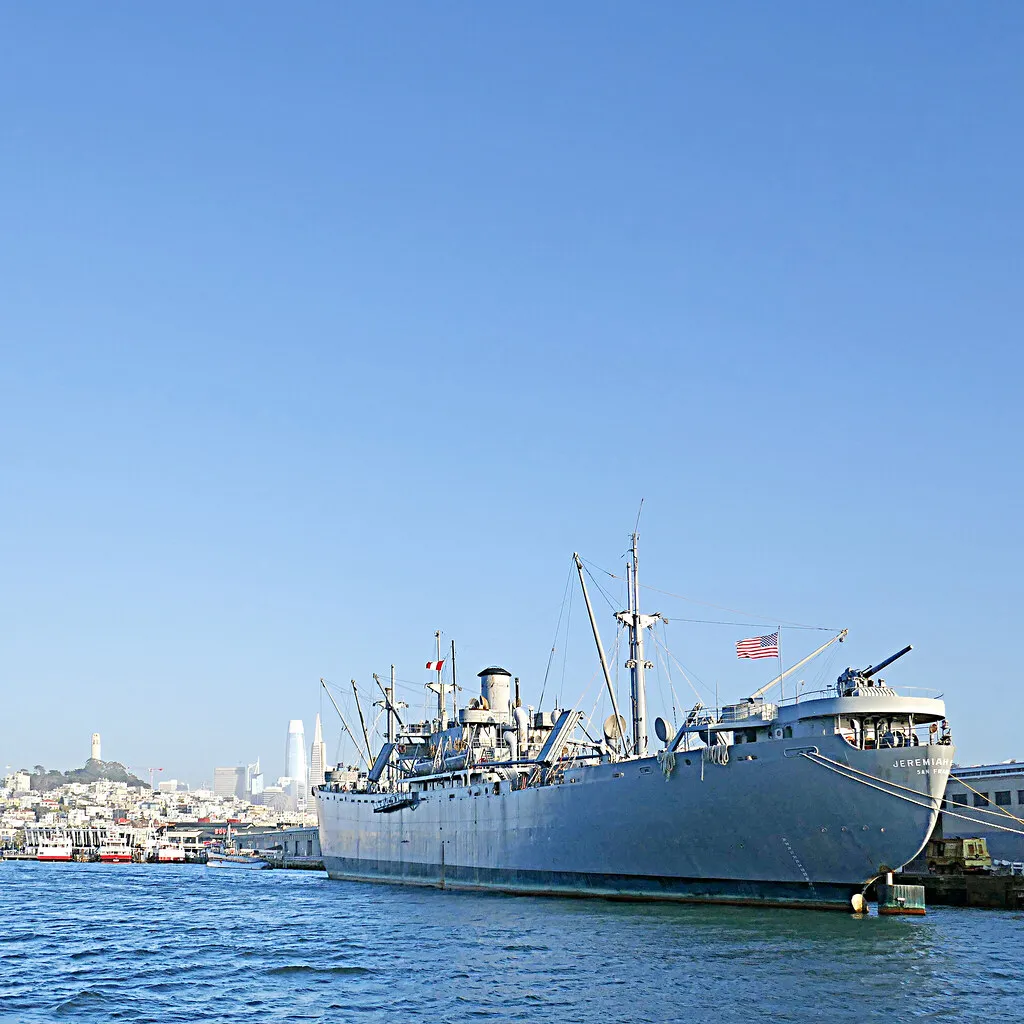
Photo: Pom' / CC BY-SA 2.0 via Flickr
Freeport Liberty Ship Reef: V.A. Fogg & WWII Wrecks
GPS coordinates, species, techniques, and WWII history for the Freeport Liberty Ship Reef — 36 nm offshore in 100 ft of water for snapper and amberjack.
The Freeport Liberty Ship Reef Complex is the most significant structured offshore destination accessible from Freeport Boat Basin. It puts three WWII-era vessels, a cluster of decommissioned oil platforms, and decades of accumulated marine life on top of one GPS waypoint: 36 nautical miles offshore, in 100 to 102 feet of water. Anglers have been running to it for red snapper, amberjack, and kingfish since the ships went down. This guide covers the history, the coordinates, the fish, and what experienced anglers actually do when they get there.
What Is the Freeport Liberty Ship Reef Complex?
The reef complex sits in Galveston Lease Block A-22 at 28° 35’ 46.485” N, 94° 48’ 41.605” W, per TPWD’s reef site brochure. It’s a multi-structure site assembled over several decades through intentional ship sinkings, retired petroleum platform donations, and contributions from energy companies and conservation groups under the Texas Artificial Reef Program.
The core of the complex is three ships: two WWII-era Liberty Ships and a T-2 tanker. Around them sit six former oil platform jackets arranged in a star pattern (the Star Reef), 300 fly-ash blocks from Houston Lighting and Power, and a welded pipe structure from Conoco and Galveston County, all documented in the TPWD brochure. The footprint is large enough that sonar reads structure across several waypoints, not one isolated target.
The reef is in federal waters, beyond the nine-mile line covered in our state versus federal waters guide. Red snapper rules here are federal, not Texas state rules; season details are in the next section.
The Ships: A WWII Story on the Gulf Floor
The three primary vessels each carried war cargo across dangerous sea lanes before being repurposed as fishing habitat. Texas acquired surplus Liberty Ships from the Maritime Administration Reserve Fleet and placed 12 of them at five reef sites along the coast in 1975 and 1976, per TPWD’s Liberty Ship history. The class is the same one shown in the hero above: the SS Jeremiah O’Brien, one of only a few Liberty Ships still afloat anywhere.
William H. Allen received the Philippine Liberation Ribbon for her crew’s service in the winter of 1944 to 1945, including support of the invasion of Leyte Island. She lies at 28° 35’ 38.954” N, 94° 48’ 44.295” W.
B.F. Shaw was awarded the Operation and Engagement Star after repelling a Luftwaffe attack while in convoy across the Mediterranean. She lies at 28° 35’ 52.612” N, 94° 48’ 41.782” W.
V.A. Fogg, the one local anglers call “the Fogg,” survived multiple Atlantic convoy crossings during the war. A benzene explosion in 1972 sank her where she now lies, at 28° 35’ 36.600” N, 94° 48’ 44.937” W. She’s a T-2 tanker, longer and differently shaped than the Liberty Ships, and a well-documented dive site that draws recreational divers on calm summer days alongside the fishing boats.
GPS Coordinates for the Full Complex
All coordinates use the NAD83 datum, from the TPWD reef brochure. Enter them into your chart plotter before departure.
| Structure | Latitude | Longitude | Depth (ft) |
|---|---|---|---|
| Center point (Reef Complex) | 28° 35’ 46.485” N | 94° 48’ 41.605” W | 100–102 |
| B.F. Shaw (Liberty Ship) | 28° 35’ 52.612” N | 94° 48’ 41.782” W | 100–102 |
| William H. Allen (Liberty Ship) | 28° 35’ 38.954” N | 94° 48’ 44.295” W | 100–102 |
| V.A. Fogg (T-2 Tanker) | 28° 35’ 36.600” N | 94° 48’ 44.937” W | 100–102 |
| HL&P Reef (fly-ash blocks) | 28° 35’ 36.065” N | 94° 48’ 45.833” W | 100–102 |
| Conoco/Galveston Co. Reef | 28° 35’ 35.593” N | 94° 48’ 43.358” W | 100–102 |
The reef orientation runs roughly north to south, and a white buoy marks the complex; it shows on radar before you reach it. The ships’ decks sit roughly 70 to 80 feet below the surface, so the fishable structure occupies the 70 to 100 foot band. Structure reads clearly on sonar.
Navigation note: the bearing from the Freeport jetties is 122° at approximately 36 nautical miles. From the Surfside jetties the run is slightly shorter, closer to 32 to 33 nautical miles on a similar heading. Verify with your own chart plotter.
What Swims at the Freeport Liberty Ship Reef
The reef supports a layered ecosystem. What you can keep changes by season, and two of the headline species carry strict 2026 windows.
| Species | 2026 season status | Notes |
|---|---|---|
| Red snapper | For-hire federal season June 1 to Oct 26, 2026 | The primary draw; fish hold tight to the ship structure |
| Greater amberjack | Federal harvest Sept 1 to Oct 14, 2026 only | 1 fish, 34” fork length; catch-and-release outside the window |
| King mackerel | Open year-round | Ribbonfish drift is the local go-to |
| Lane snapper | Open year-round | Smaller than reds; consistently present |
| Gray triggerfish | Seasonal closures apply | Check current federal status before keeping |
| Grouper (various) | Complex seasonal rules | Check NOAA Gulf grouper regulations |
| Cobia (ling) | Spring migration, April to May | Follows the same current rips that bring them inshore |
| Sharks | Year-round | Blacktip, tiger, dusky, and hammerhead documented at the site |
| Atlantic spadefish | Year-round | Abundant around structure |
| Wahoo, barracuda | Occasional | Confirmed but not primary targets |
For the amberjack release problem in particular, our DESCEND Act and reef fish release guide walks through venting and descending technique for fish pulled up from 100 feet.
How Local Anglers Fish It
The reef fishes several ways depending on the target. The techniques below reflect how experienced Freeport-area anglers approach the site.
Snapper: work tight to the ship structure. The fish hold right on the wreck surface, sometimes within 10 to 15 feet of the deck. Drop a heavy jig head with a soft plastic or fresh-cut bait straight down to deck level and work it up. Bait that drifts off the structure consistently produces smaller or off-target fish. If you’re not hung up occasionally, you’re probably not close enough.
Amberjack: AJs roam the mid-column above the reef and respond to live bait and heavy butterfly jigs dropped into the 60 to 90 foot range. During the short harvest window they stack up fast. The rest of the year they’re a catch-and-release fight, and a fish pulled from that depth needs a descending device to survive the release.
Kings: kingfish hold at the reef year-round and the white buoy area attracts them reliably. The standard local approach is a ribbonfish drift: ribbonfish on a wire rig, lines out on a slow drift around the structure. Kings in the 15 to 30 pound class are common. Trolling the reef perimeter with cigar minnows or live bait on planer rigs also produces.
Grouper and lane snapper: both come up alongside red snapper when the structure is fished hard. Lane snapper carry no closed season; grouper rules are complicated enough that you should check NOAA’s current Gulf grouper regulations before keeping anything.
Crowds and divers: on calm summer weekends this is one of the most visited offshore destinations on the upper Texas coast, and divers work the same structure anglers fish. Plan mid-week when possible, or arrive early and be ready to shift to adjacent structure.
Can Your Boat Make the Run?
The complex is 36 nautical miles out. That’s an honest bluewater run, not a near-shore trip.
Freeport Liberty Ship Reef Complex
- 36 nm from Freeport jetties, bearing 122°
- 100–102 ft water depth
- Federal waters; federal snapper rules apply
- Ships + Star Reef + HL&P + Conoco structures
- Full species mix: snapper, AJ, kings, grouper, cobia
- Fuel: minimum 80+ nm round trip with reserve
George Vancouver (alternative)
- 9 nm from Freeport; reachable for most boats
- 45 ft water depth
- State waters; Texas snapper rules apply
- Single Liberty Ship (State Tract 336-L)
- Snapper, triggerfish, redfish reported
- GPS: 28° 47' 34.817" N, 95° 20' 52.052" W
If your boat handles 36 miles of Gulf water, the full complex is worth the run. If fuel range or sea state limits you, the George Vancouver gives you Liberty Ship structure at 9 nm in state waters, shallower at 45 feet and with far less fish-holding material. Check current conditions on the Freeport fishing report before you commit to the longer run.
For a first trip to the offshore wrecks, a charter out of Freeport Boat Basin is the practical option: purpose-built boats that run this route weekly, with the fuel, redundancy, and crew experience the trip calls for.
FAQ
How far is the Freeport Liberty Ship Reef from Freeport?
The reef complex is approximately 36 nautical miles from the Freeport jetties on a heading of 122 degrees. From the Surfside jetties the distance is slightly shorter, around 32 to 33 nautical miles. The trip takes roughly 1.5 to 2 hours each way depending on sea conditions and vessel speed.
What fish are caught at the V.A. Fogg reef?
The V.A. Fogg and the surrounding Freeport Liberty Ship Reef Complex hold red snapper, amberjack, king mackerel, lane snapper, grouper, gray triggerfish, cobia, Atlantic spadefish, and sharks. Kings are a year-round target; snapper and amberjack follow federal seasons.
How deep is the Freeport Liberty Ship Reef?
The water depth over the reef complex is 100 to 102 feet, and the decks of the sunken ships sit roughly 70 to 80 feet below the surface. That puts the fishable structure in the 70 to 100 foot range, a productive depth zone for red snapper and other Gulf reef species.
Is the Freeport Liberty Ship Reef in state or federal waters?
The reef complex is in federal waters, beyond the nine-nautical-mile Texas state boundary. Red snapper fishing there follows federal season rules; the 2026 for-hire season runs June 1 to October 26. Texas state rules apply only inside nine miles.
Can you dive the V.A. Fogg?
Yes. The V.A. Fogg is an established dive site and draws recreational divers alongside anglers, particularly on calm summer days. The structure at 70 to 80 feet is accessible to intermediate divers and is considered one of the more interesting wreck dives on the upper Texas coast. Mid-week trips are less crowded for both fishing and diving.
What is the George Vancouver reef near Freeport?
The George Vancouver (State Tract 336-L) is a separate Liberty Ship reef just 9 nautical miles from Freeport, in 45 feet of water within Texas state waters. It’s reachable by smaller boats that can’t safely run 36 miles offshore, and holds snapper and other reef species on a smaller scale. GPS: 28° 47’ 34.817” N, 95° 20’ 52.052” W.
Planning an offshore trip to the Liberty Ship Reef? Connect with a Freeport charter captain who runs this route regularly.
Find a Freeport Charter Captain
All Brazosport Fishing Spots
Frequently Asked Questions.
How far is the Freeport Liberty Ship Reef from Freeport?
The reef complex is approximately 36 nautical miles from the Freeport jetties on a heading of 122 degrees. From the Surfside jetties the distance is slightly shorter, around 32 to 33 nautical miles. The trip takes roughly 1.5 to 2 hours each way depending on sea conditions and vessel speed.
What fish are caught at the V.A. Fogg reef?
The V.A. Fogg and the surrounding Freeport Liberty Ship Reef Complex hold red snapper, amberjack, king mackerel, lane snapper, grouper, gray triggerfish, cobia, Atlantic spadefish, and sharks. Kings are a year-round target; snapper and amberjack follow federal seasons.
How deep is the Freeport Liberty Ship Reef?
The water depth over the reef complex is 100 to 102 feet, and the decks of the sunken ships sit roughly 70 to 80 feet below the surface. That puts the fishable structure in the 70 to 100 foot range, a productive depth zone for red snapper and other Gulf reef species.
Is the Freeport Liberty Ship Reef in state or federal waters?
The reef complex is in federal waters, beyond the nine-nautical-mile Texas state boundary. Red snapper fishing there follows federal season rules; the 2026 for-hire season runs June 1 to October 26. Texas state rules apply only inside nine miles.
Can you dive the V.A. Fogg?
Yes. The V.A. Fogg is an established dive site and draws recreational divers alongside anglers, particularly on calm summer days. The structure at 70 to 80 feet is accessible to intermediate divers and is considered one of the more interesting wreck dives on the upper Texas coast. Mid-week trips are less crowded for both fishing and diving.
What is the George Vancouver reef near Freeport?
The George Vancouver (State Tract 336-L) is a separate Liberty Ship reef just 9 nautical miles from Freeport, in 45 feet of water within Texas state waters. It's reachable by smaller boats that can't safely run 36 miles offshore, and holds snapper and other reef species on a smaller scale. GPS: 28 degrees 47' 34.817" N, 95 degrees 20' 52.052" W.